

Answer Engine Optimization (AEO)!
What Is Answer Engine Optimization (AEO) All About?
When someone asks an AI for a product recommendation, they don't scroll through ten search links—they get a quick, confident answer naming two or three top brands. Answer Engine Optimization (AEO) ensures your brand is one of them. This hype-free guide breaks down what AEO is, why it matters for your business, and how to put it into practice.
What is AEO?
Answer Engine Optimization (AEO) is the practice of getting your brand cited and recommended in AI-generated answers—across platforms like ChatGPT, Perplexity, Gemini, Claude, and Google AI Overviews.
Why Does It Matter Now?
For two decades, standard search meant typing a query into Google, getting a page of links, and clicking through.
Today, buyers ask an AI assistant to do the heavy lifting, relying on a single synthesized answer. If the AI doesn't mention your brand, you effectively don't exist to that buyer.
The real danger isn't a drop in your traditional analytics—it's silently losing customers you never even knew were looking for you.
AEO vs SEO: How They Differ!
AEO is not a replacement for SEO. It is a close cousin that measures and optimizes for a different surface.
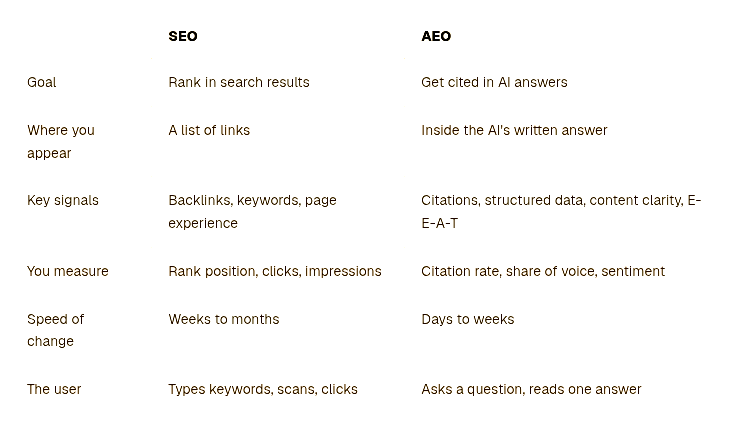
They overlap more than they differ. Both reward clear, well-structured content from a credible source. The smart move for most brands is to optimize once for both and measure them separately.
How Does AEO Actually Work?
The process is defined and processed via the following three layers…
1. Visibility, which is knowing where you stand. You cannot improve what you cannot see. The first step is tracking how often each AI engine mentions you, how you compare to competitors, what sources the models cite, and whether they describe you positively or not.
2. Diagnosis, which is knowing why. Mentions are an outcome, not a cause. AI engines tend to cite content that is clear, well-structured, and backed by authority. So AEO looks at the underlying signals: is your content easy for a model to parse, is your structured data in place, do you have the experience and trust signals (E-E-A-T) that models lean on, and are you cited by sources they already rely on.
3. Action, which is actually improving. This is the part that moves your numbers. It means publishing content built to be cited, earning mentions on authoritative publishers the models trust, and fixing the structural gaps the diagnosis surfaced. Tracking shows you the problem. Action is what closes it.
Provide Content That Gets You Cited!
If you remember nothing else, remember that AI engines are trying to give a trustworthy answer. They favor brands and pages that make that easy. In practice that means they cite brands who provide the most:
1) Clarity
Content that answers a question directly, in plain language, with a clean structure the model can lift from.
2) Structure
Headings, lists, schema markup, and a logical hierarchy that signals what your content is about.
3) Authority
Real expertise, credentials, and being referenced by sources the model already trusts. This is where authoritative publisher placements matter.
4) Consistency
Being mentioned across many trusted sources, not just on your own site, so the model sees a pattern.
AEO As A Needs To Progress!
Answer Engine Optimization (AEO) is essential and must be implemented into your digital marketing efforts if you want to grow as a brand. Utilize free tools out there like Google Analytics to track your digital marketing efforts.
The fastest first step is to see how the AI engines currently treat your brand: how often they mention you, where you trail competitors, and what is holding your score back. From there, AEO becomes a normal optimization loop. Measure, diagnose, act, repeat.
The brands that start now are building an advantage that compounds, because once an engine learns to trust and cite you, it tends to keep doing it!